
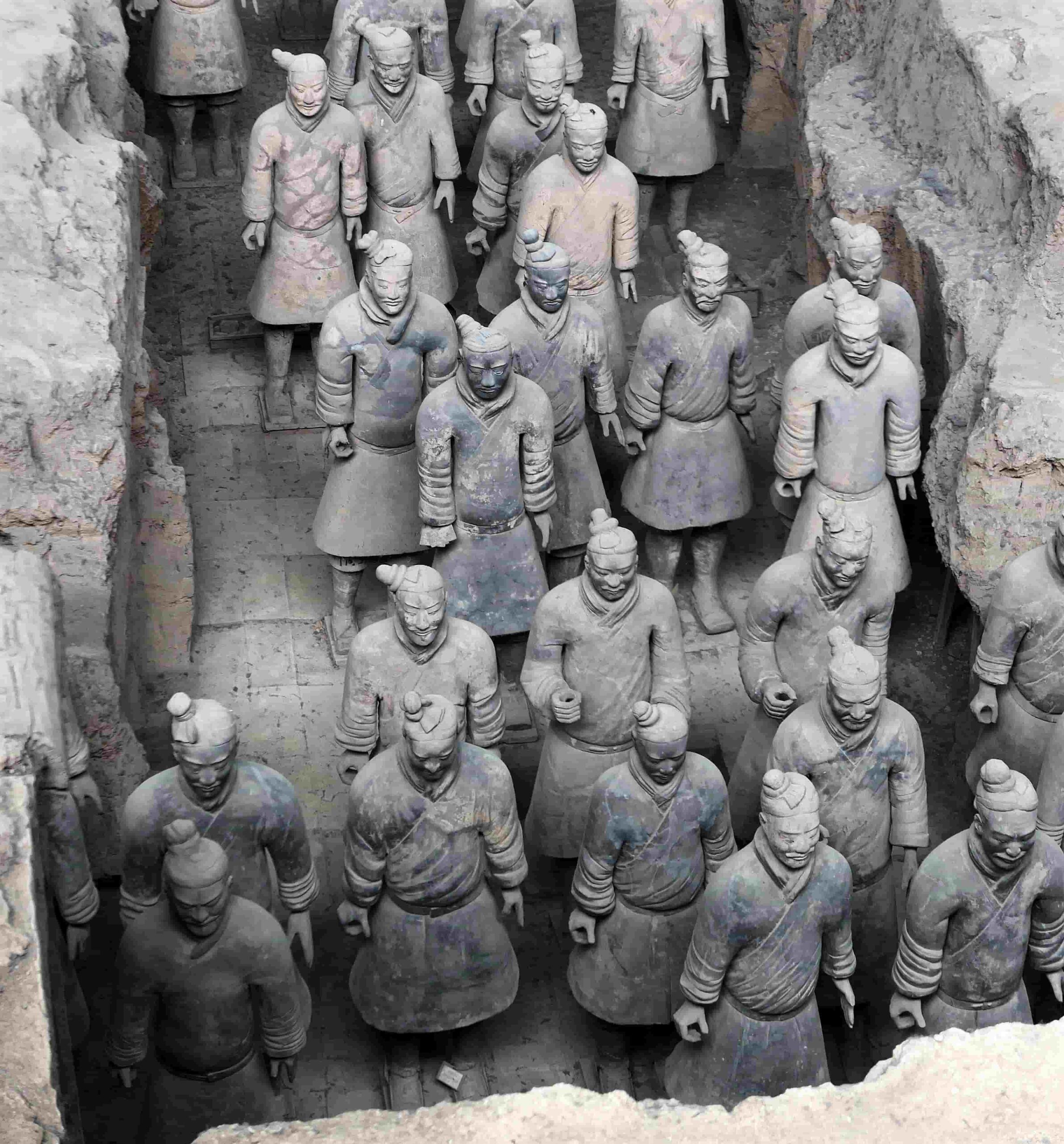
There’s nowhere else in China where you can truly stop, stare and then completely reassess everything you thought you knew about the ancient world. Here’s why the Emperor Qinshihuang’s Mausoleum Site Museum in Xi’an should be on your bucket list, a 2,200-year-old, sprawling underground empire that lay buried under the fields of China’s Shaanxi province until 1974 – a discovery which would rewrite the course of history for good. In this ultimate guide, we go through everything you need to know before visiting China’s Terracotta army.
Who Was Emperor Qin Shi Huang?
Before you head to the museum, it would be beneficial to get acquainted with the man whose life and reign gave birth to the site you’ll be exploring:
Emperor Qin (259 BC – 210 BC), originally named Ying Zheng, came to the throne of the State of Qin at just 13 years old. He had accomplished what no other king before him had – conquered the remaining 6 rival states, unifying China under one imperial hand. Ying Zheng officially declared himself the first emperor of a united China, and gave China a name we still recognize; ‘Qin’ has formed the foundation of ‘China’ from that day on.
He established systems of weights, currency, writing and measures that would govern the empire and commissioned the building of a colossal fortification that was intended to defend China – the eventual Great Wall.
The very day Ying Zheng ascended the throne as a mere teenager, he began constructing the mausoleum where he’d be laid to rest. His long life became a meticulous planning session for death – the outcome, quite frankly, is an incredible feat of engineering and art that continues to awe visitors today.
The Discovery That Shocked the World
In March 1974, a group of farmers near Lintong District in Xi’an were digging a well when their shovels struck something unusual — terracotta fragments, a head, a hand. Archaeologists were called in. What they uncovered would become known as the Eighth Wonder of the World.
Beneath the ground lay an army. A life-sized Terracotta Army of soldiers, horses, and chariots — each one individually crafted, each face unique, each figure placed in strict military formation. They had been standing in the dark for over two millennia, silently guarding their emperor.
To date, archaeologists have uncovered more than 8,000 terracotta warriors, along with 130 chariots and 520 horses. And excavations are still ongoing.
What Is the Emperor Qinshihuang’s Mausoleum Site Museum?
The museum is not one building. It is a complex spread over two main areas:
- The Terracotta Warriors Museum (Qin Terracotta Warriors and Horses Museum)
This museum is what most visitors come to see. They should. It has three excavation pits: Pit 1, Pit 2, and Pit 3, and an exhibition hall with some amazing artifacts from the site. - Lishan Garden (Emperor Qinshihuang’s Mausoleum Site Park)
This is an archaeological park that surrounds the emperor’s burial mound. It covers 226 hectares. It has several small museums, ritual sacrifice pits and the tomb mound. The tomb mound is a huge earthen pyramid that has not been fully dug up yet.
You can visit both areas with one ticket. There is a free bus that takes you between them.
Inside the Pits: What You Will See
Pit 1 — The Grand Army
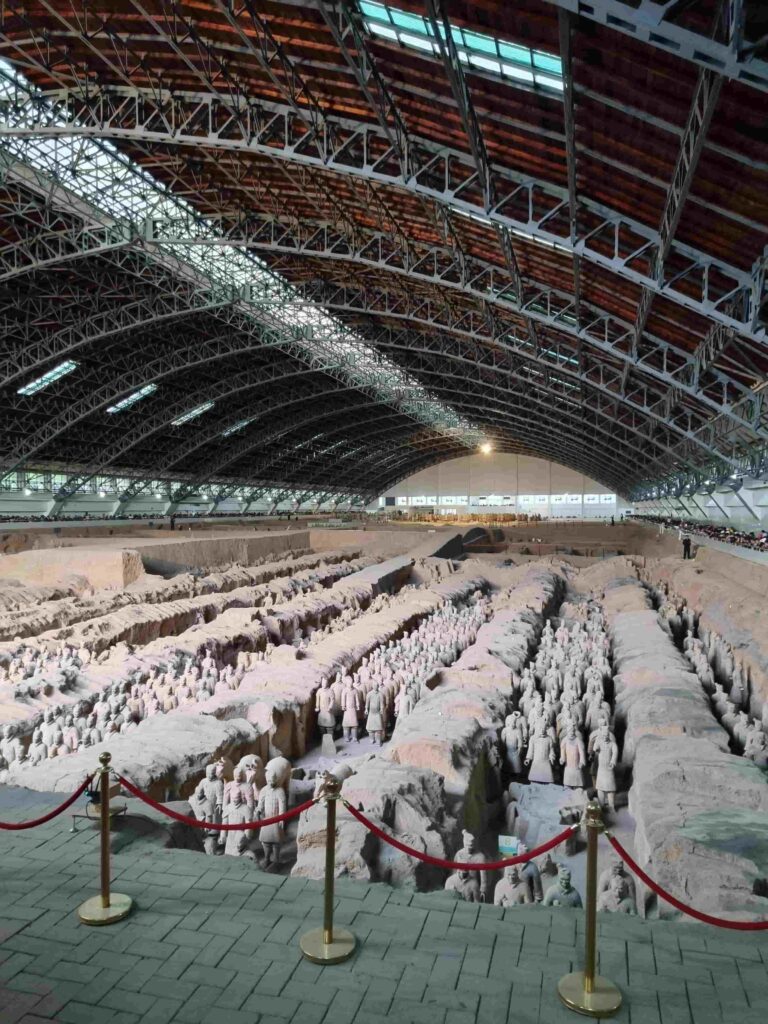
This is the main event. Pit 1 is the largest of the three excavation pits, stretching 210 meters long and 61 meters wide — roughly the size of two football fields placed side by side. Inside, more than 6,000 life-sized terracotta soldiers stand in precise battle formation, arranged in columns and rows that stretch as far as the eye can see.
The scale of it is genuinely difficult to process. You stand on a raised walkway above the pit and look down at this silent army, and for a moment the 2,200 years between you and them seem to collapse entirely. Start here. No other pit will hit you the same way.
Pit 2 — The Diverse Troops
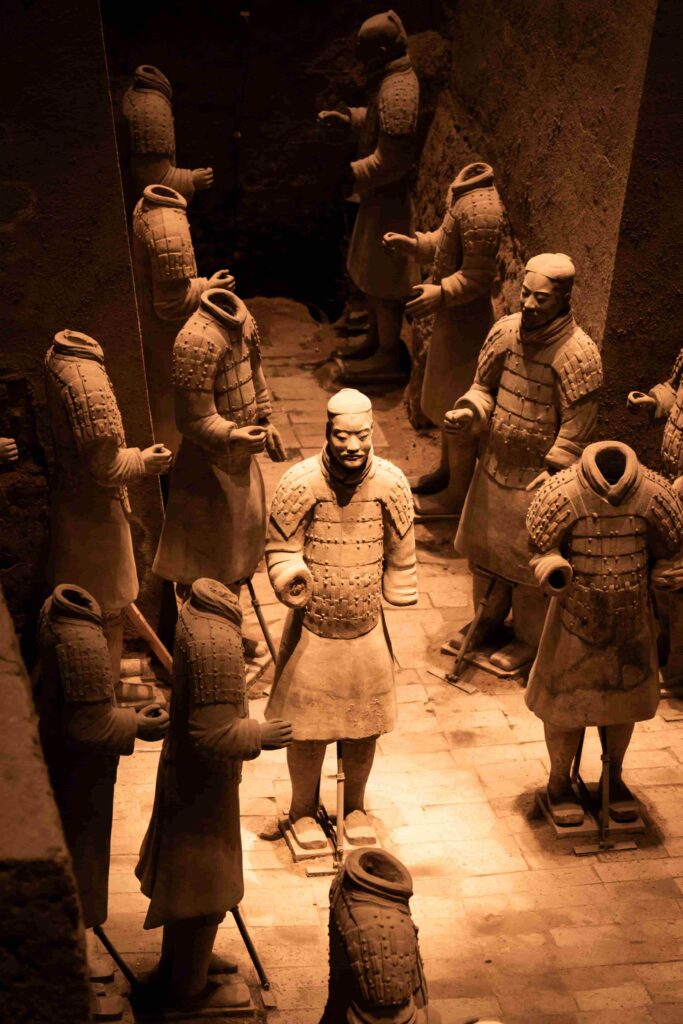
Smaller than Pit 1 but arguably more interesting in detail, Pit 2 contains a wider variety of military units: archers, cavalry soldiers, war chariots, and infantry. Some of the figures here are displayed up close in glass cases, giving you a rare chance to examine the extraordinary craftsmanship — the individual strands of hair, the layered armor, the expressions that seem almost alive.
Pit 3 — The Command Center
The smallest of the three pits is believed to have served as the headquarters of the army. It contains high-ranking officers and a single war chariot, along with evidence of rituals that suggest this was the spiritual nerve center of the entire underground force.
The Bronze Chariots Exhibition Hall
This is one of the most underrated highlights of the entire site. Two half-size bronze chariots were excavated near the main mausoleum mound, and they are among the finest examples of bronze craftsmanship from the ancient world. The level of detail — the reins, the canopy, the decorated surfaces — is extraordinary.
The Acrobatics Pit (K9901)
Discovered in 2011 within the Lishan Garden section, this pit contains terracotta figures of acrobats and court entertainers rather than soldiers. The figures range from muscular strongmen to slender performers, offering a rare and fascinating glimpse into the entertainment culture of the Qin court.
The Tomb Mound: The Secret That Remains Underground
1.5 kilometers from where the warriors are buried, inside Lishan Garden, there is a big grassy hill. This is where Emperor Qin Shi Huang is actually buried. It has never been opened.
Historical records from a historian named Sima Qian from the Han Dynasty describe what is inside: an underground palace with rivers of mercury flowing through it, a ceiling with pearls to show the stars, and a lot of treasures. Modern soil tests have found a lot of mercury in the ground around the hill, which suggests that the old records might be true.
The Chinese government has decided not to dig it up. They think that today’s technology cannot keep what they find in good condition. The tomb is just waiting. That is the most interesting part of the whole story.
Practical Information
Location: Lintong District, Xi’an, Shaanxi Province — approximately 37 km east of Xi’an city center.
Opening Hours:
- Peak season (March 16 – November 15): 08:30 – 18:30
- Off-season (November 16 – March 15): 08:30 – 17:30
Ticket Price:
- Peak season: 120 RMB per person
- Off-season: 100 RMB per person
- The ticket covers both the Terracotta Warriors Museum and the Lishan Garden mausoleum park.
How to Book: Book in advance through the official Emperor Qinshihuang’s Mausoleum Site Museum website or the WeChat account of the Emperor Qinshihuang’s Mausoleum Site Museum. Real-name registration with ID is required. During peak season (May Day, National Day, summer holidays), book at least 10 days in advance — tickets sell out fast.
How to Get There from Xi’an
By Metro and Bus:
Take Metro Line 9 to Huaqing Pool Station. Then get on Bus No. 613 to the site. The total journey takes around one and a half hours.
By Tourist Bus:
A tourist bus goes from near the Bell Tower, which is east of the Yisushe Grand Theater. Another bus leaves from near the Giant Wild Goose Pagoda, at the Dayanta Vienna Hotel. The fare for one way is thirty yuan. It takes one hour.
By Taxi:
This is the most comfortable way. A trip from the center of Xi’an city takes around one hour. It costs one hundred and sixty to two hundred and twenty yuan.
By Car:
Go to the “Emperor Qinshihuang’s Mausoleum Site Museum Parking Lot.” Parking costs twenty yuan per entry. Do not use unofficial parking lots. They often charge too much.
Tips for Visiting
Get to the museum early:
The museum opens at 8:30 AM. If you go there when it opens or after 3:00 PM, you will not have to deal with many people and you can take better pictures.
First go to Pit 1:
It is really amazing. Look at the pits and exhibition halls later, after you have seen Pit 1 and the other pits, so it is not so overwhelming.
You should get a guide or use an audio guide:
The Terracotta Warriors are great to look at. To really understand what you are seeing, you need to know what is going on. A guide will tell you about the army formations and the different types of soldiers. A guide will also tell you how they were made and the story behind the Terracotta Warriors. A good guide makes the visit much better.
Plan for 3 to 4 hours minimum:
It is going to take 3 to 4 hours. If you want to see the Terracotta Warriors Museum and then go to Lishan Garden and the tomb mound, you will need at least half a day.
Best seasons to visit:
The best time to visit the museum is in the spring from March to May or in the autumn from September to November. The weather is nice. It is good for walking around outside.
Avoid visiting in summer without preparation:
Do not go in the summer without being prepared. It is very hot from June to August. There are a lot of people. If you do go in the summer, try to get to the museum when it opens.
Final Thoughts
There are places in the world that feel significant before you even arrive. The Emperor Qinshihuang’s Mausoleum Site Museum is one of them. You know the history. You have seen the photographs. And still, when you walk into Pit 1 and see that army stretching out beneath you — thousands of faces, thousands of lives, thousands of years — nothing quite prepares you for it.
This is not just a museum. It is the ambition of a man who refused to accept that death was the end. And in a strange way, he was right.
The Terracotta Army is still standing. It has been standing for over two thousand years. And it will be standing long after all of us are gone.
Inspired by the history of the Terracotta Warriors? Continue your journey through China’s past with our guide to the Great Wall of China, another essential stop for any history enthusiast.




Great content! Keep up the good work!
Thanks Man for the appreciation