The Grand Palace Bangkok is a place where, when you are standing at the entrance gates on Thanon Na Phra Lantha, the size of the place hits you right away. There is a white wall with points on top that goes on for a very long time. That wall runs for 1,900 meters, enclosing thirty acres of the most amazing buildings in Asia.
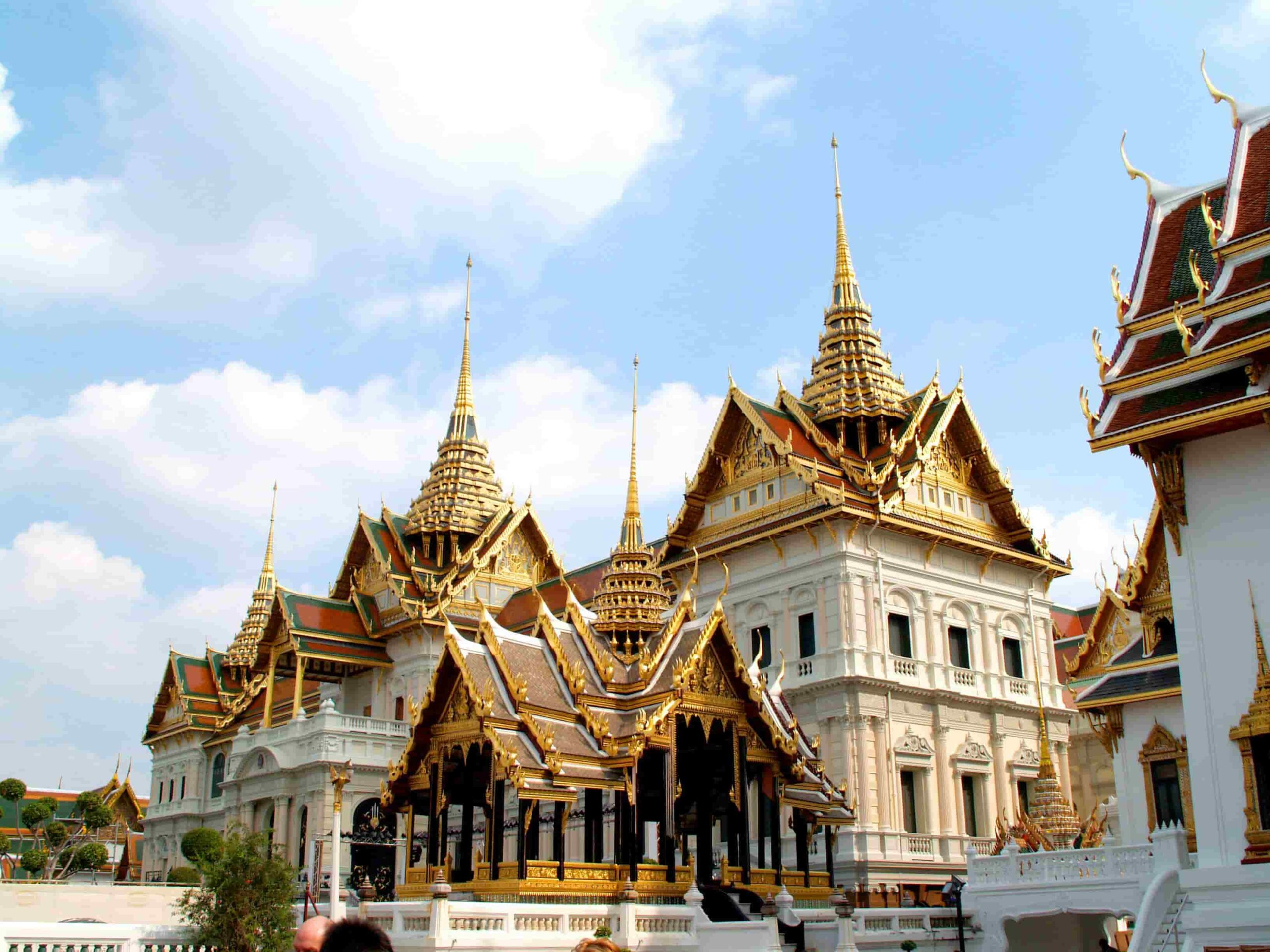
The golden tops of Wat Phra Kaew are behind this wall. They shine really bright in the morning sun. The way they shine is like they are giving off light without caring, and it is almost too much to look at. You have to squint because of how bright it is. You need to put on your sunglasses because of the light. Then you go inside Wat Phra Kaew.
The palace dates back to 1782, when King Rama I moved Siam’s capital to Bangkok and began building a home for the new royal dynasty. Construction didn’t stop with him — nine more Chakri kings added to the complex over the following two centuries, each layering in new halls, temples, and artistic touches. What stands today is essentially two hundred years of royal ambition, compressed into thirty acres of gold and stone.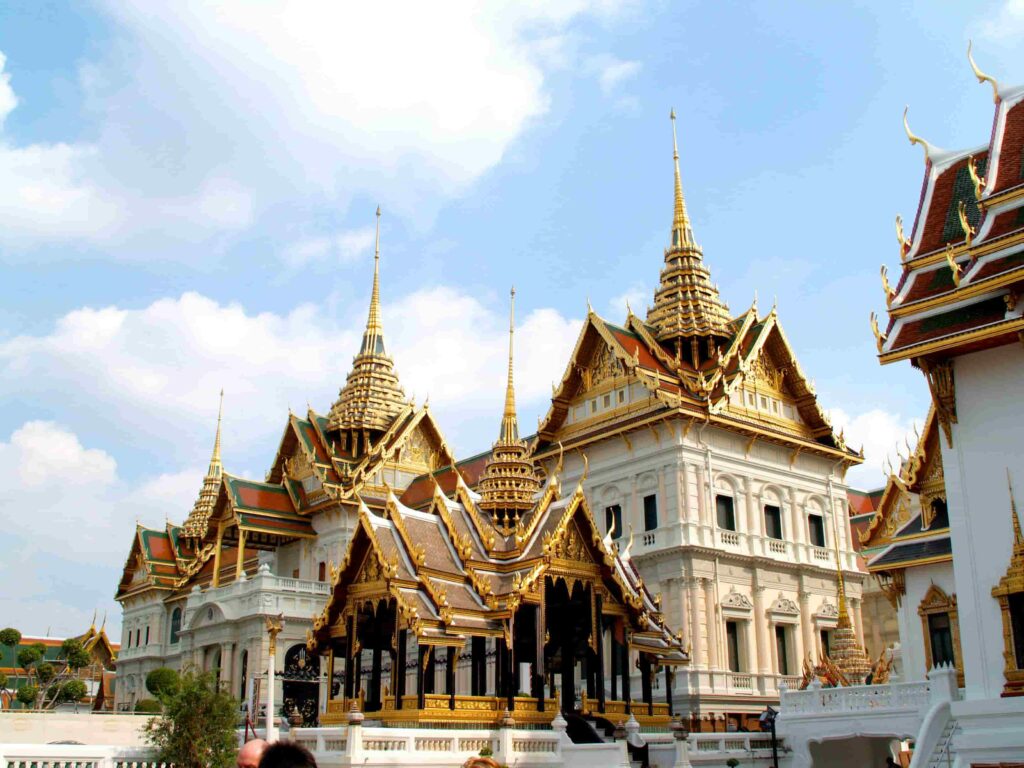
Wat Phra Kaew — The Temple of the Emerald Buddha
Nothing in the Grand Palace complex — nothing in Bangkok, arguably nothing in Thailand — prepares you for the interior of Wat Phra Kaew, the Temple of the Emerald Buddha. You approach through courtyards lined with demon guardian statues that stand six meters tall in lacquered armor and expressions of magnificent ferocity, past gallery walls painted with the entire 178-panel mural of the Ramakien — Thailand’s version of the Ramayana epic — in colors so vivid they seem to hum.
Then you enter the temple and there he is: the Emerald Buddha sitting high on a golden altar that is almost eleven meters tall. He’s smaller than you’d expect — just 66 centimeters — which somehow makes his presence feel even stronger. He is carved from one piece of green jade. He sits in meditation with an authority that makes the huge hall feel cozy. The room is always quiet, in a way that feels natural.
Three times a year, at the start of each season, the King of Thailand personally changes the Emerald Buddha’s robes — a plain one for summer, a gilded one for the rainy season, and one adorned with gold and diamonds for the cool season. The King has carried out this ceremony since 1784, unbroken for over two centuries. It still happens today. When you are in the room where this happens, you can feel how special and important this tradition is. The fact that it has been going on for so long is really something to think about.
To stand before the Emerald Buddha is to understand that some objects accumulate not just age but meaning — that two and a half centuries of prayer, devotion, and royal ceremony can make a piece of jade into something that has no adequate secular description.
Where East Meets West in Gold
The palace buildings themselves — distinct from the temple — are a fascinating document of Thai history in the nineteenth century, when Siam was navigating the colonial age through a policy of selective modernization. The grandest of the palace halls, the Chakri Maha Prasat, built in 1882, is the most visible expression of this negotiation: a fundamentally European neoclassical building topped, at the last moment, with three traditional Thai spired roofs. Bangkok wits of the time called it “a farang wearing a chada” — a Westerner in a Thai crown.
The result, whatever its diplomatic origins, is genuinely extraordinary — a hybrid that shouldn’t work and does, magnificently. Inside, the throne halls are preserved exactly as they were used: state portraits, European furniture upholstered in Thai silk, crystal chandeliers over mosaic floors, royal regalia in glass cases that include crowns so encrusted with diamonds they look unreal.
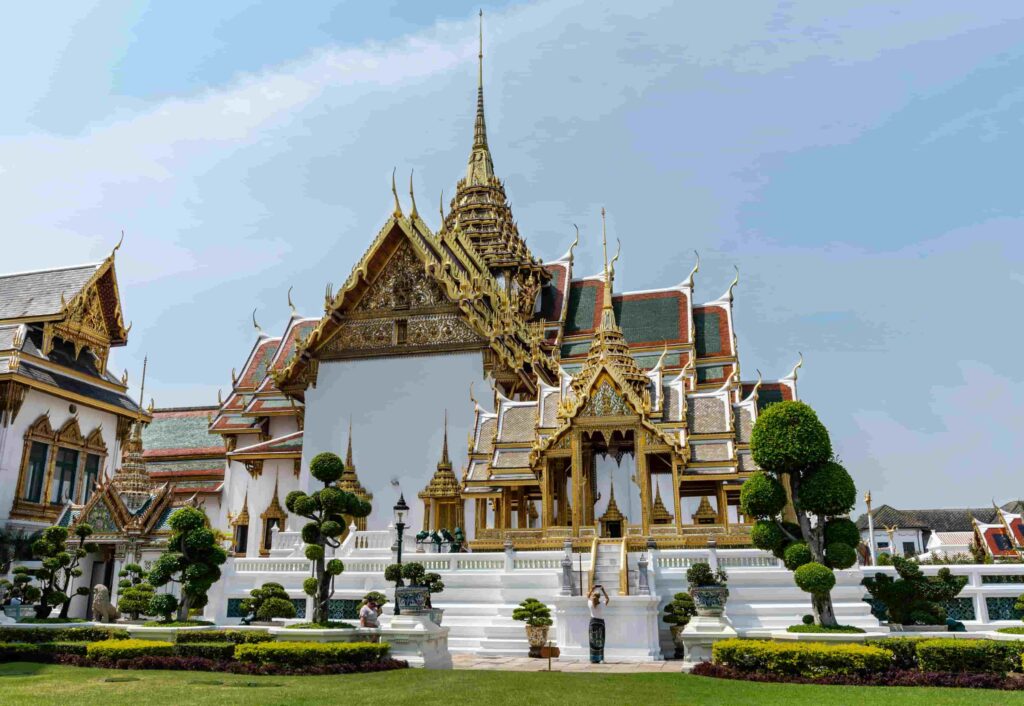
The Phra Sri Rattana Chedi, the golden stupa in the temple compound, is covered entirely in gold mosaic tiles and contains a relic of the Buddha. On clear days it is visible from across the Chao Phraya — a beacon that has oriented this city for over two hundred years.
What Nobody Tells You Before You Go
The Grand Palace gets a lot of visitors—over eight million every year. That’s 22,000 people per day when it’s busiest. Despite the crowds, an early visit can still feel surprisingly personal. Arrive at 8:30 AM, before the cruise-ship tour buses roll in from the Chao Phraya, and the complex is quiet — golden roof tiles catching the soft morning light with almost nobody else around.
The Ramakien mural gallery deserves at least an hour, though most visitors rush past it on their way to the Emerald Buddha. Slow down here — the 178 panels wrap around the entire Wat Phra Kaew compound, telling the story of Rama’s battle against the demon king Ravana through armies of monkeys, animal-headed demons, royal processions, and gardens rendered in impossibly vivid color. Look closer and you’ll find eighteenth-century daily life tucked into the corners too — food vendors, sleeping guards, children at play — small details easy to miss if you’re moving too fast.
After the palace, walk west along the river to Wat Pho — the Temple of the Reclining Buddha — five minutes away and technically a separate complex but spiritually and historically continuous with the Grand Palace. The reclining Buddha here is 46 meters long, and its gold-inlaid feet, each divided into 108 auspicious panels, are among the most serene and slightly surreal things you’ll see on this or any other trip.
Everything You Need to Know Before You Visit
- Entry: 500 THB Per Person
Includes entry to Wat Phra Kaew, the palace buildings, and the Coin Pavilion. Buy only at the official ticket counter — no online booking. Ticket includes same-day entry to Dusit Palace.
- Hours: 8:30 AM – 3:30 PM Daily
Open every day including public holidays except during major royal ceremonies. Last admission 3:30 PM. Allow at least 3 hours — 4 if you want to do justice to the Ramakien murals.
- Getting There: Chao Phraya Boat
Take the Chao Phraya Express Boat to Tha Chang Pier (N9) — it’s a 5-minute walk to the entrance. Far faster and more enjoyable than fighting Bangkok traffic by road.
- Dress Code: Shoulders & Knees Covered
Strictly enforced. Shorts, sleeveless tops, and revealing clothes are not permitted. Sarongs and shawls are available to borrow at the entrance gate at no cost.
- Best Season: November to February
Cool season brings lower humidity and temperatures around 28–32°C. March–May is very hot. June–October is rainy season — afternoon downpours are common but the palace stays open.
- Photography: Allowed — With Respect
Photography is permitted throughout the complex except inside the bot (inner shrine hall) of Wat Phra Kaew. Photography of the Emerald Buddha itself is strictly prohibited. Respect the space.
Two Centuries of Gold & Glory
Still Shine
This isn’t a museum, and it isn’t a ruin either — it’s a place still very much alive. Ceremonies still happen here, monks still care for the grounds, and pilgrims and visitors alike arrive from around the world to stand in its courtyards. Come at sunrise if you can, when the golden chedi catches the first light and the whole complex feels less like a monument and more like something still breathing history.
Final Thought
More than a checkbox attraction, and more than a fragment of a bygone age, the Grand Palace is the breathing, living soul of Thailand. It’s one of the few places in the world that will actually stop the clocks, and transport you far away from this world of modern marvels, to a bygone world of centuries of prayer, artistic merit and regal majesty.
Whether you will feel dazed by the blinding gleam of morning on the gilded spires, be immersed in the 240-year-old, complex stories told in the Ramakien murals or simply feel awestruck and silent before the Emerald Buddha, it’s one of those experiences to remember this world by.
What makes it linger, long after you’ve left, isn’t just the scale of the gold or the age of the stone. The monks still walk these courtyards. The King still changes the Buddha’s robes with the seasons, just as his predecessors have since 1784. The ceremonies haven’t become performances; they’re still the reason the place exists in the first place. Most travelers pass through in three hours, snap their photos of the golden spires, and move on to the next stop on the list — and there’s nothing wrong with that.
But the Grand Palace rewards anyone willing to slow down, even briefly: to sit in the shade of a gallery wall and actually read the story in the Ramakien murals, or to simply stand still in front of the Emerald Buddha and let the quiet of the room do what it’s clearly done for pilgrims for over two centuries.
If the Grand Palace has you hooked on Thailand’s royal history, Ayutthaya — the ancient former capital — is the natural next stop, or head south to unwind at Maya Bay after all that temple-hopping.