
Imagine this.
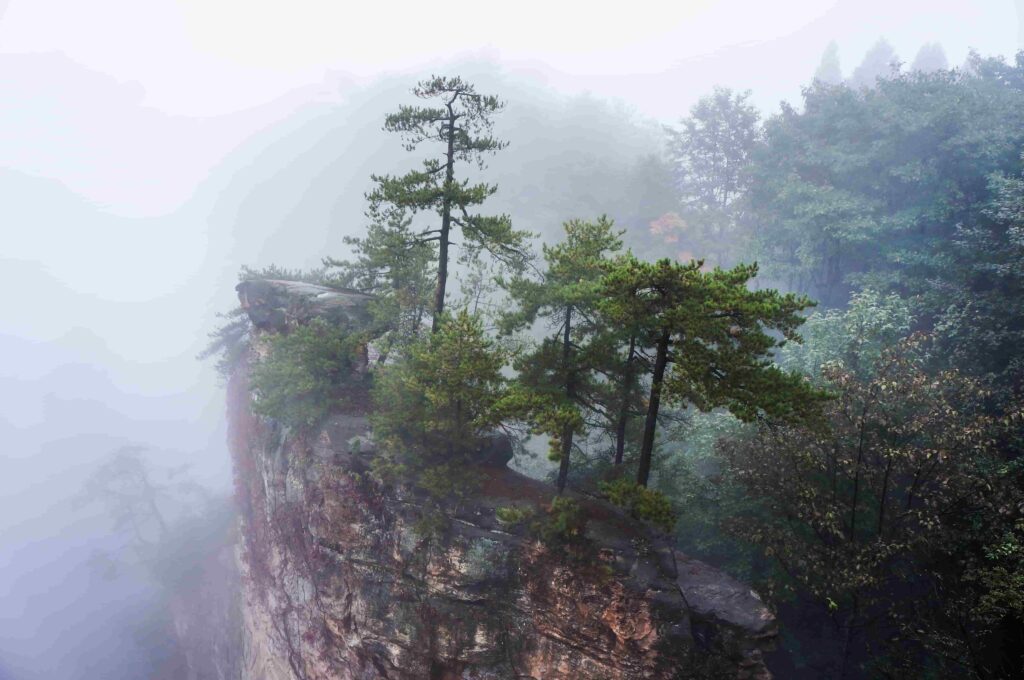
You are in Zhangjiajie National Forest Park, China, when it’s 7 o’clock in the morning. It is cold, damp and you are standing on a ridge, in southern China, a coffee warming your hands, your feet — nothing below you but white. A limitless sea of cloud that engulfs the entire valley beneath and then from within it, one by one, they begin to rise; giants stirring in their sleep.
Pillars. Hundreds of them. Huge pillars of rock rising hundreds of metres straight out of the white nothingness, each one adorned with green pine trees; each one more preposterous than the next. No ground visible. No bottom. Just impossible stone columns suspended on nothingness, silent and gargantuan; as if someone paused the world for a dream and forgot to restart it.
I have visited over forty countries. I have watched sunrises over the fields of Cambodia. I have eaten noodles at 3am on the back streets of Tokyo and driven the Karakoram Highway through my home backyard. I have witnessed sights that have truly taken my breath away.
Nothing – and I mean nothing – could have prepared me for Zhangjiajie National Forest Park China.
Wait, You Have Not Heard of Zhangjiajie?
That is okay. Most people have not heard — at least not by name — Zhangjiajie National Forest Park China.
But here is what you definitely have seen: Avatar. James Cameron’s 2009 film. The one with the blue people and the floating mountains of Pandora that looked too beautiful to be real.
Here is the secret Cameron never made a big deal of — those mountains ARE real. Every last one of them. Zhangjiajie National Forest Park China gives these vibes of Avatar.
The floating Hallelujah Mountains of Pandora? They are the quartzite sandstone pillars of Yuanjiajie, right here in Hunan Province, China. Cameron’s team came here, looked around, and essentially said: we found our alien planet. They were not wrong. Standing at the Yuanjiajie viewing platform, I felt like I had stepped into a different world entirely. My brain genuinely struggled to accept what my eyes were showing it.
These columns — some as thin as a chimney, some as wide as a building — were formed over 380 million years of geological pressure and erosion. Three hundred and eighty million. That number means nothing until you are standing in front of one of these pillars and realising it was already ancient when dinosaurs existed.
On the misty mornings, which are most mornings here, the fog fills the valleys between the pillars and you see only their tops poking through. The effect is so otherworldly, so genuinely surreal, that I stood at that viewing platform for forty-five minutes without moving.
My coffee went cold. I did not notice.
The Glass Bridge That Turned My Legs to Jelly
I’ll be honest. I’m not a person afraid of heights. I have bungee jumped. I trekked cliff edges in Gilgit-Baltistan without breaking a sweat. I have leaned so far over the railing of a viewpoint in northern Pakistan that my traveling companion was holding onto my jacket.
And still I got goosebumps at Zhangjiajie Grand Canyon Glass Bridge. That’s why I like Zhangjiajie National Forest Park China.
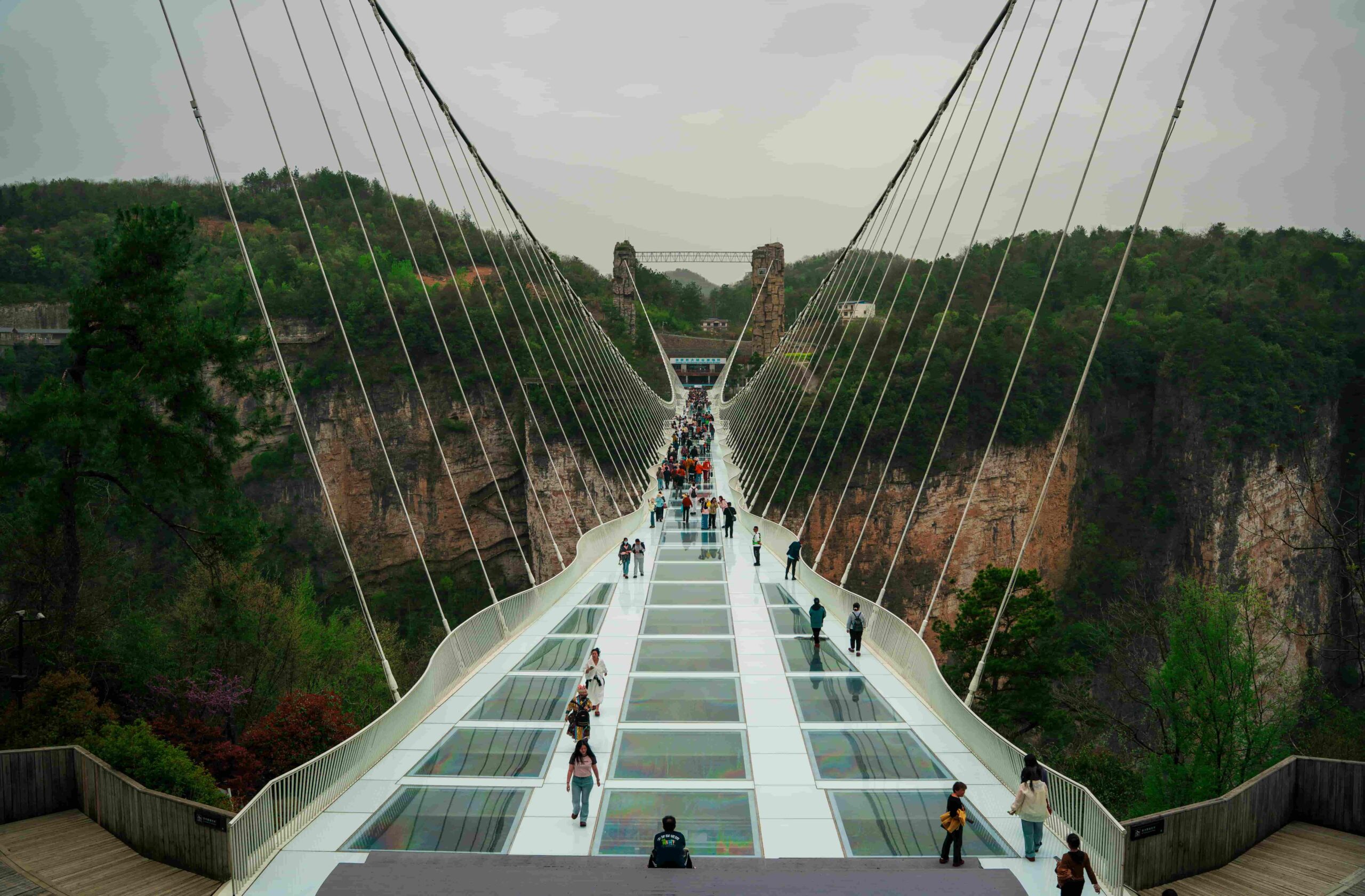
So the reality is this. The bridge is 430 meters long. The walkway hangs 300 meters above the valley floor. Underneath your feet is glass – 24 layers of it that have been tested to support 40 times the weight of all allowed visitors. It is one of the most structurally sound bridges on the planet.
But this fact does not help the first time you take a step and look down.
You do not see the bridge beneath you. You see through it. Through the glass, through the open air, through hundreds of metres of nothing, to the tiny green forest far below that looks like a carpet of moss from up there. The bridge sways — gently, barely — in the mountain breeze. And somewhere in your brain, a very old, very primal alarm starts ringing.
I stopped three times in the first fifty metres to breathe.
Around me, the reactions were delightful. A group of Chinese tourists ahead of me were shrieking and laughing simultaneously. A young woman sat down cross-legged in the middle of the bridge and flatly refused to move. Her friends spent a full five minutes negotiating with her — she eventually agreed to crawl forward on her hands and knees rather than walk. An older man near me gripped the railing so hard his knuckles went white and then looked at me with wide eyes and said something in Mandarin that I am fairly confident translated as “why did we come here.”
But here is the thing about fear — real, physical, primal fear. When you push through it, what comes out the other side is pure, unfiltered awe.
By the halfway point I had stopped gripping the rail. I was standing in the middle of a glass bridge three hundred metres in the sky, looking out at forested cliffs on both sides of me, watching thin white waterfalls drop hundreds of metres down the rock faces, watching cable car gondolas move silently in the distance like slow-moving stars. And I thought — this. THIS is why I travel. Not for the photos. Not for the content. For this exact feeling. Of being reminded, in the most physical way possible, how enormous and magnificent the world actually is.
The Cable Car That Will Ruin All Other Cable Cars for You
Before Zhangjiajie National Forest Park China, I thought I had experienced cable cars.
I had not experienced cable cars.
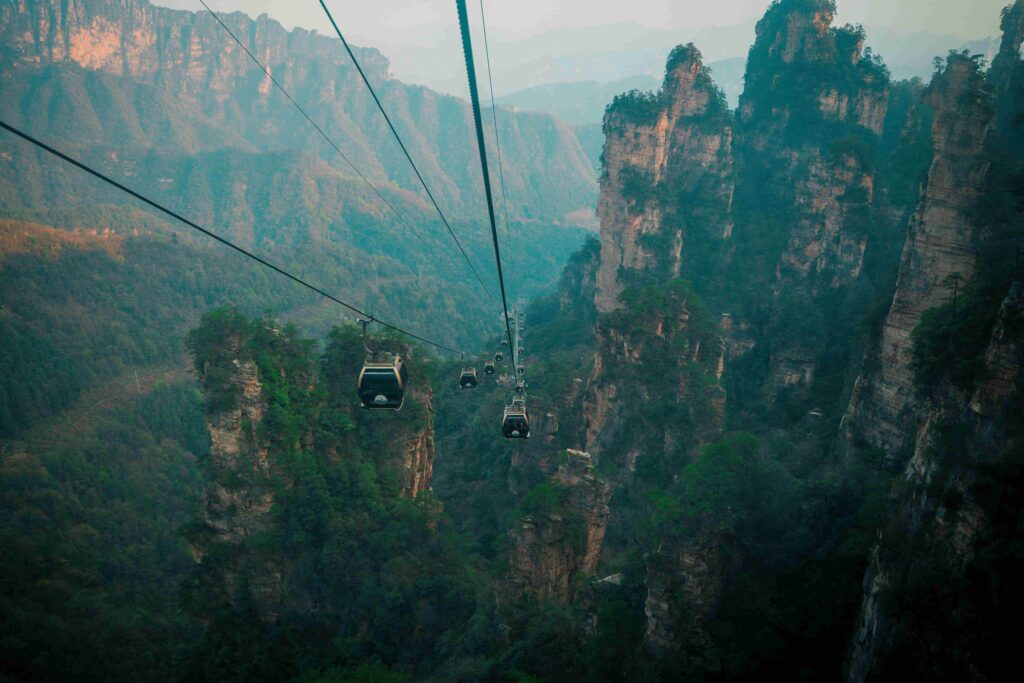
The Tianmen Mountain cable car is the longest passenger cable car in the world — 7.5 kilometres, stretching from the city of Zhangjiajie up to the summit of Tianmen Mountain. The ride takes about thirty minutes. For most of those thirty minutes, you are suspended in a small gondola, floating silently through clouds, watching the landscape beneath you become more and more extraordinary with every metre of altitude you gain.
From up in the air, the pillars of the national park are even more dramatic than from the ground. You see them from above, from the sides, through gaps in the mist. Some are so narrow at their base that physics feels like it is being broken. Yet somehow trees grow on top of them — full-sized pine trees, their roots gripping bare rock hundreds of metres in the sky, absolutely refusing to give up.
At the summit of Tianmen Mountain, you step out onto cliff-face walkways — some with glass floors — where you can look straight down the vertical face of the mountain. And then there is Heaven’s Gate.
A natural arch, carved through the mountain by thousands of years of wind and rain, 131 metres tall. You walk through it. The sky is visible through it on both sides. And standing inside it, with the mountain above you and the clouds below you, something in your chest goes very quiet and very still.
But I understood, in that moment, why people built temples on mountains.
What Nobody Tells You About Zhangjiajie
The food in Hunan cuisine will leave you stunned. It has one of the best regional cooking traditions in China. It is spicy, bold and full of flavor. After you have been hiking and walking on the glass bridge all day sitting down to eat a plate of Mao’s Red Braised Pork, which is a specialty of Hunan cuisine, feels like the universe is saying sorry for all the pain in your legs. You should eat at lots of places. You should eat often. Do not go to restaurants that serve tourist food instead of local food. That would be a shame.
The crowds of people are not too bad if you plan your trip smartly. If you can visit on weekdays, get to the viewpoints before 8 AM and do not go during national holidays. The park is really big, even with a lot of visitors, many of the trails are quiet and feel relaxed.
The hike up the mountain is worth it. Yes, there are elevators and cable cars and escalators on the mountain. You can use those to get down. You should walk up at least one of the main trails. The views from the middle of the mountain, where the mist is all around you and the pillars of rock appear and disappear as you climb, are different from the views at the top. These views are more personal. They are more magical. They are more worth the pain in your thighs from walking.
You should get a guide to show you around for at least one day. The park is really big. It covers over 400 kilometres. And most of the best places to see are not the obvious tourist spots. A good guide knows which viewpoint is best to see the mist at sunrise, which trail is quiet at noon, and which noodle shop near the east gate of Zhangjiajie has the best breakfast. That kind of knowledge, from a guide, is worth every penny you pay for it.
Your Practical Guide to Zhangjiajie
Getting There
Zhangjiajie National Forest Park China has its own airport — Zhangjiajie Hehua International Airport — connected to Beijing, Shanghai, Guangzhou, Chengdu, and other major Chinese cities. From Pakistan, fly into Beijing or Shanghai and catch a domestic connection. The whole journey takes roughly 12–16 hours depending on your layover.
Best Time to Visit
🌸 Spring (March–May): The mist is at its most dramatic. Everything is lush and green. This is peak Zhangjiajie season and for good reason. Best time to visit Zhangjiajie National Forest Park China.
🍂 Autumn (September–November): Cooler temperatures and autumn colours on the foliage. Stunning in a completely different way.
☀️ Summer (June–August): Hot, humid, and crowded. Still beautiful but less comfortable.
❄️ Winter (December–February): Cold but magical — snow-capped pillars emerging from white mist. Fewer tourists. Worth considering for adventurous travelers.
Where to Stay
The city of Zhangjiajie offers everything from budget guesthouses under $20/night to comfortable mid-range hotels. For a memorable experience, book one of the hotels inside the scenic area itself — waking up inside the park, with the mist outside your window, is something you will tell people about for years. Book these months in advance.
How Many Days
Three days minimum. Four to five is ideal. The national park, Grand Canyon area, Tianmen Mountain, and surrounding villages each deserve a full day. This is not a place to rush. The mountains have been here for 380 million years. They can afford to wait. So can you.
Budget
Zhangjiajie National Forest Park China
| Item | Approximate Cost |
|---|---|
| Park entrance (combined ticket) | 245 CNY (~$34 USD) |
| Tianmen Cable Car (return) | 258 CNY (~$36 USD) |
| Glass Bridge ticket | 138 CNY (~$19 USD) |
| Budget hotel per night | 150–300 CNY |
| Local meals per day | 60–100 CNY |
The Honest Truth About Zhangjiajie
Most asked question — after forty countries, after all the temples and beaches and mountain passes and ancient cities — what is the one place that genuinely changed how I see the world?
I used to give different answers depending on my mood. Cambodia for the soul. Japan for the mind. Pakistan for the heart.
Now I have a new answer.
Zhangjiajie changed the way I see what is possible. Not what is possible for humans to build or create or achieve — but what is possible for the planet itself. What the Earth, left to its own devices over hundreds of millions of years, is capable of producing. The answer, apparently, is something so beautiful and so strange that filmmakers use it as their alien world. Something so extreme that people sit down on glass bridges and refuse to move. Something that makes forty-five minutes disappear while your coffee goes cold in your hand.
If you are planning a trip to China — whether it is your first time or your fifth — do not let Zhangjiajie National Forest Park China be the place you add to a list and never book. Do not save it for “someday.” Someday has a habit of never arriving.
Go. Stand on that glass bridge. Let the mist swallow the valley beneath you. Watch the stone giants emerge from the clouds at dawn.
You will not be the same person coming down the mountain as you were going up.
And that — that is the whole point of travel, is it not?
Final Thoughts
Here is the truth nobody tells you about Zhangjiajie before you go.
You will see hundreds of photos of this place before you arrive. On Instagram, on travel blogs, on YouTube vlogs. You will think you are prepared. You will think you know what it looks like.
You do not. Not until you visit Zhangjiajie National Forest Park China by yourself.
No photograph — not even a good one, not even a great one — captures what it actually feels like to stand inside that landscape. The scale is wrong in pictures. The silence is missing. The cold damp air on your face is missing. The way the mist moves — slowly, then suddenly, swallowing a pillar whole in seconds — cannot be captured in a frame. The way your chest tightens on the glass bridge when you first look down. The way your legs feel heavy and light at the same time on the cable car. The way time stops working properly when you are watching stone giants emerge from clouds at sunrise.
These things only exist if you go.
I have said this about very few places in my years of travel. Most places are wonderful. Most places reward a visit. Only a handful of places in the world reach into your chest and rearrange something permanently. Zhangjiajie National Forest Park China is one of those places.
Go before the crowds grow larger. Go before the ticket prices rise. Go before the next wave of tourists discovers what the Avatar fans already know. Go while the trails are still quiet in the early morning and the mist is still thick in the valleys and a woman with a cart still sells noodles near the east gate for twelve yuan.
Go now. The mountains have been waiting 380 million years. That is why Zhangjiajie National Forest Park China is loved by humans.
But you — you have waited long enough. And you can find the same vibes in Penang Hill Malaysia that you have found in Zhangjiajie National Forest Park China.

This is that article what i am looking for i really want the details about this bridge now i got it
Wow the glass bridge sounds absolutely terrifying! I had no idea Zhangjiajie was the inspiration for Avatar. This has gone straight to my travel bucket list. Amazing write up