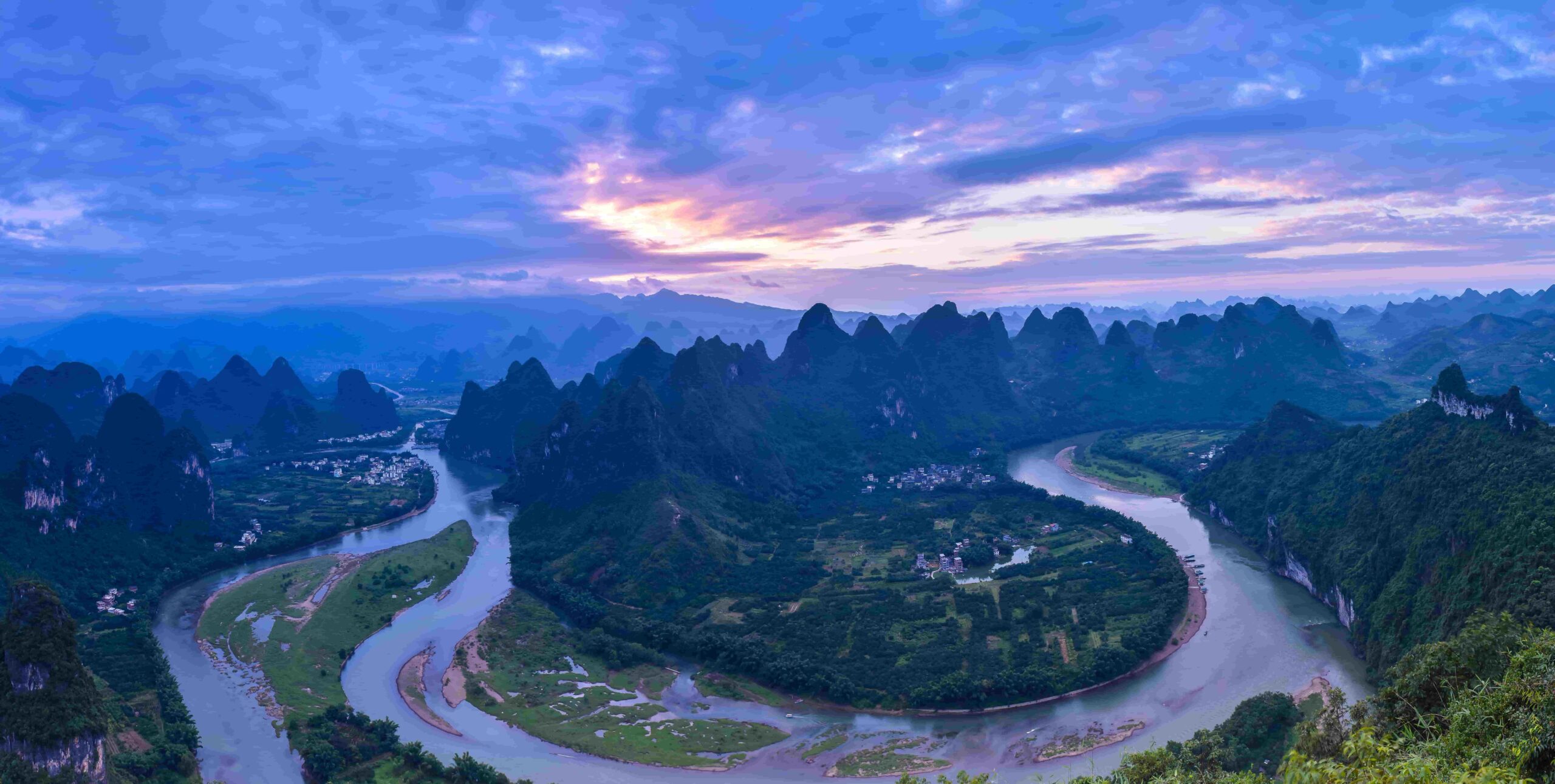
China really loves its landscapes. Only one of them is on the money. If you turn over a 20 yuan note, you will see the Li River near Xingping with the mountains and everything. The note does not tell you that the real thing is even nicer and getting to that spot is not as easy as just walking down to the river. It needs a proper plan for getting there.
If you are going to Guilin or Yangshuo in China, you should not just add the Li River to your trip at the minute. You should plan your trip around the Li River. Here is what you need to know before you go to the Li River, and most of this is the kind of thing you can only learn by doing it and figuring it out for yourself when you are there.
Where Exactly Is the Li River
Flowing through China’s southern Guangxi province, the Li River connects the busy city of Guilin to the much smaller and more laid-back town of Yangshuo. The most beautiful part – specifically the section of river around Xingping – is where the karst peaks truly show their colours. But don’t think of this as just a pretty rural river; this karst landscape has influenced life and land use here for centuries, and it is why this particular corner of Guangxi landed on so many postcards.
Most travellers choose one or the other – or both – to base their Li River excursion out of: Guilin is the larger of the two cities and has the airport and main train station; Yangshuo is smaller, more sedate, and a bit nearer to the core of the region’s most picturesque parts.
If you have the time, try to stay a night or two in each.
Getting There
Guilin has its own airport called Liangjiang International that takes domestic flight arrivals from Beijing, Shanghai, Guangzhou as well as some international destinations. If you are coming from somewhere else within China, high-speed rail is really the easiest bet. The two towns even have their own train stations these days, and if you’re originating in a major hub such as Guangzhou, you will only be on the train for a few hours. If coming from Guilin, you will be between an hour and an hour and 20 minutes by bus or car, or you can ride the river between the two, since the cruise itself doubles as the transit between Guilin and Yangshuo.
The River Cruise Experience
This is the main event. It’s the reason most people show up here at all.
You can experience the Li River in two basic forms: the longer cruise between Guilin and Yangshuo, or shorter bamboo raft trips on the waters of Yangshuo and Xingping. Do both if you have the time.
Otherwise, don’t miss the cruise.
The standard trip is 4-5 hours long, 80-some km, and follows the river as it winds past a series of officially named, poetically christened rock formations – a variety called “Painted Hill of Nine Horses”, for example, or the “Yellow Cloth Shoal,” to mention but two of the more prominent examples – each with a story attached. The boats are huge, many-decked vessels with interiors and open decks and they typically provide lunch on board.
If you go on a big cruise boat, get to the uppermost deck as quickly as possible because the best seats (which provide the best view) fill up within minutes of the first few really dramatic views, which happen in the second half of the journey. For smaller, quieter, closer to water experience, try the bamboo raft cruises from Yangshuo and Xingping – usually an hour or two long and offering you the same views at a much slower pace and closer to water level.
The View From Above: Xingping’s Viewpoints
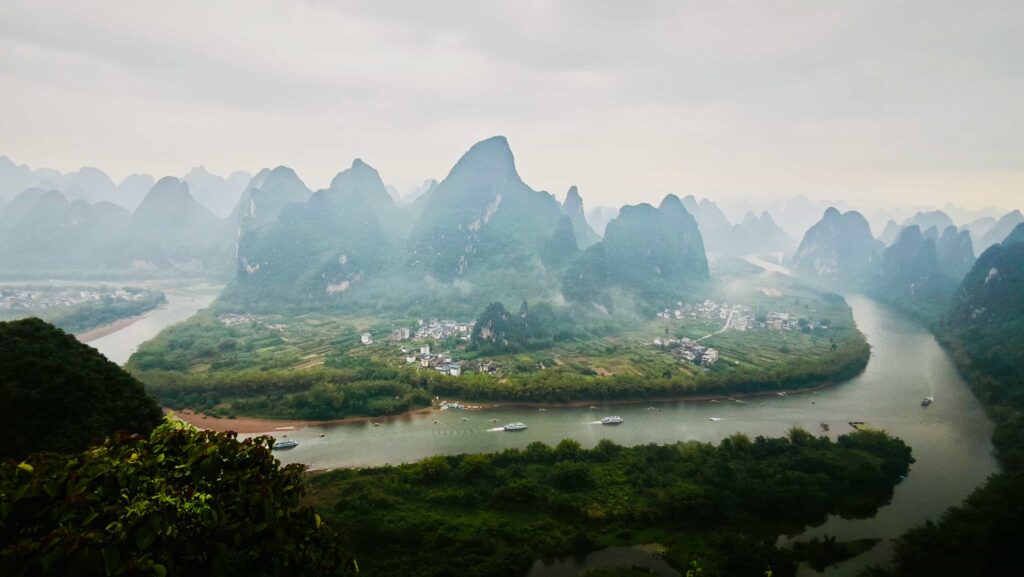
Here is something that a lot of people get wrong when they visit for the first time. The picture of the river that you see on the banknote does not come from the river at all. The picture is taken from above from a hill near Xingping where the river bends.
There are a few places where you can take this picture, but most people go to Xianggong Hill. It is a walk with steps cut into the side of the hill, and depending on the time of year, you will be hot and tired by the time you are halfway up. It is worth it. From the top of Xianggong Hill you can see the river curving around a piece of land with fields and a small village inside the curve and lots of hills fading into the distance behind it.
Go to Xianggong Hill at sunrise or late in the day if you can — the light is nicer and there are fewer people around. Xianggong Hill does get crowded with photographers climbing up before it gets light to get a spot, so if you want to take pictures, you should get up early and get moving.
Xingping Ancient Town
There’s a point of interest you may find by not just hurrying through Xingping en route to the viewpoint. It is a classic riverfront city, filled with slim stone roads, older, weathered buildings of timber, and a pace far slower than Yangshuo or Guilin. A lot of it still feels like it was and could continue to be used by local residents, rather than simply created by entrepreneurs to serve outsiders.
Purchase coffee, noodles, or something from one of the small merchants alongside the central road.
Go down towards the river; you’ll be lucky enough to observe old-timers using cormorant birds for fishing, just as generations have done in the past, if they are active.
Yangshuo: Your Base for Everything Else
Yangshuo is more than a quick stop on a cruise. Many travelers end up staying for their whole trip and it’s easy to see why.
West Street is the street for pedestrians and it’s full of cafes, bars, and small shops. It stays late into the night. Yes, it can feel like a place for tourists. It’s a comfortable place to be and it’s a good base for planning trips to the countryside.
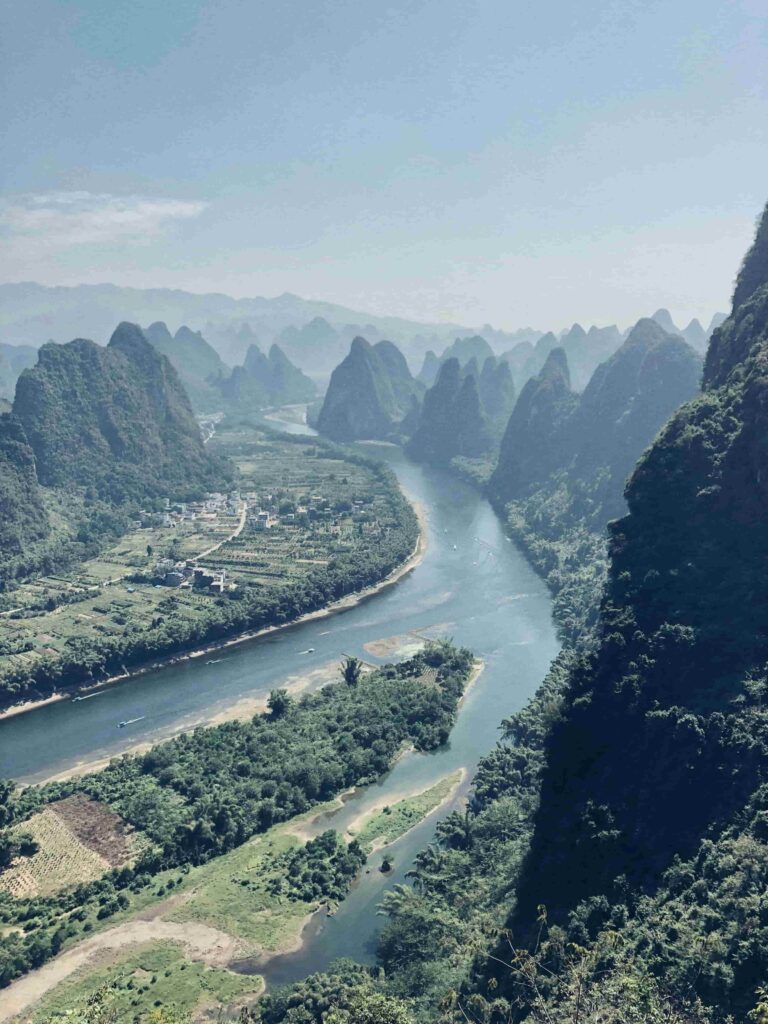
There are ways to spend a day in Yangshuo. One of the ways is to go cycling. You can rent a bike. Ride along the Yulong River. The river is a part of the bigger river and it has its own set of beautiful mountains and scenery. You can ride through rice fields and small villages.
Rock climbing is also popular in Yangshuo. The limestone in the area makes it perfect for climbing. There are guides who can help beginners learn how to climb.
Best Time to Visit
Spring (March–May) and autumn (September–November) are the best windows to visit — the weather stays mild, without summer’s humidity or winter’s grey chill. It is usually misty and rainy all year round. This actually makes the place feel more special.
Many beautiful pictures of the Li River were taken on mornings, not on sunny days.
In the summer, there are a lot of people. It is very hot. Sometimes there are rainstorms.
Winter is quieter. though a boat ride can feel cold and a little flat compared to the other seasons.
If you do not like crowds, you should not visit during holidays like Golden Week in October. This is because a lot of people from China visit during this time, and it gets very crowded.
Practical Travel Tips
Things I’d want to know before showing up here myself:
- Book cruise tickets ahead of time in peak season, especially spring and autumn weekends. The good morning slots go fast.
- Wear proper shoes if you’re hiking up to any viewpoint. The steps are uneven in places and get slippery after rain.
- Carry cash, or make sure your mobile payment apps are set up. Smaller vendors and rural stops don’t always take foreign cards.
- Pack layers. Mornings on the river run cool and misty even when the afternoon warms right up.
- Motion sickness prone? Sit on the open deck during the cruise rather than inside. The fresh air genuinely helps.
- A basic translation app goes a long way once you’re outside the touristy stretch of Yangshuo. English isn’t widely spoken in smaller towns like Xingping.
-
At a Glance Verdict
Category Rating Scenery 5/5 Ease of access 4/5 Value for money 4/5 Family friendly 4/5 Photography opportunities 5/5 Crowds (peak season) 3/5
Final Thought
Few destinations live up to their name once you see them firsthand, but the Li River does. You will be struck when you read descriptions of places in China online or see some photos. And when you stand on that hillside above Xingping overlooking the river bending below, with layer after layer of mountains shrouded in the hazy distance, it makes you feel like you are dreaming because you will wonder whether such a place could be real.
It is for this reason that for hundreds of years people have praised this river, whether for painting or writing a poem.
It does not matter whether you take a one-day tour along the cruise, or spend one week exploring the mountains near Yangshuo, this river is a destination in China which you should be dedicated to, rather than just a passing place on the way.
If you enjoyed the Li River, you’ll definitely want to visit Zhangjiajie National Forest Park too, home to the towering sandstone pillars that helped inspire the floating mountains in Avatar, another one of China’s landscapes that genuinely has to be seen to be believed.