There’s a moment when you first see the Faisal Mosque, where you just stop. You aren’t planning to it just happens. Your eyes get wide your feet slow down. For a some seconds you will forget what you are doing.
That’s what the Faisal Mosque is like. It doesn’t ask for your attention politely. It just takes it.
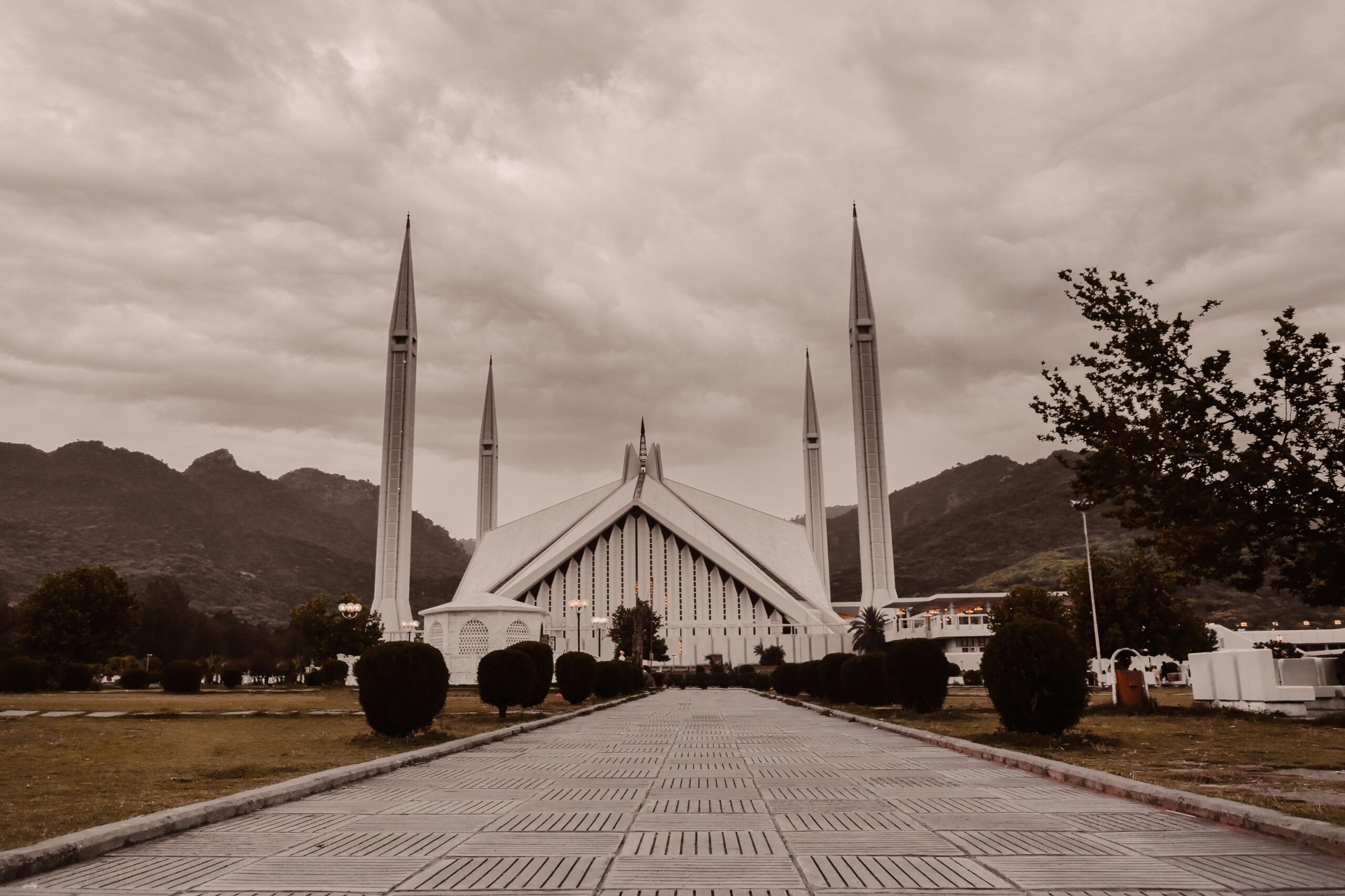
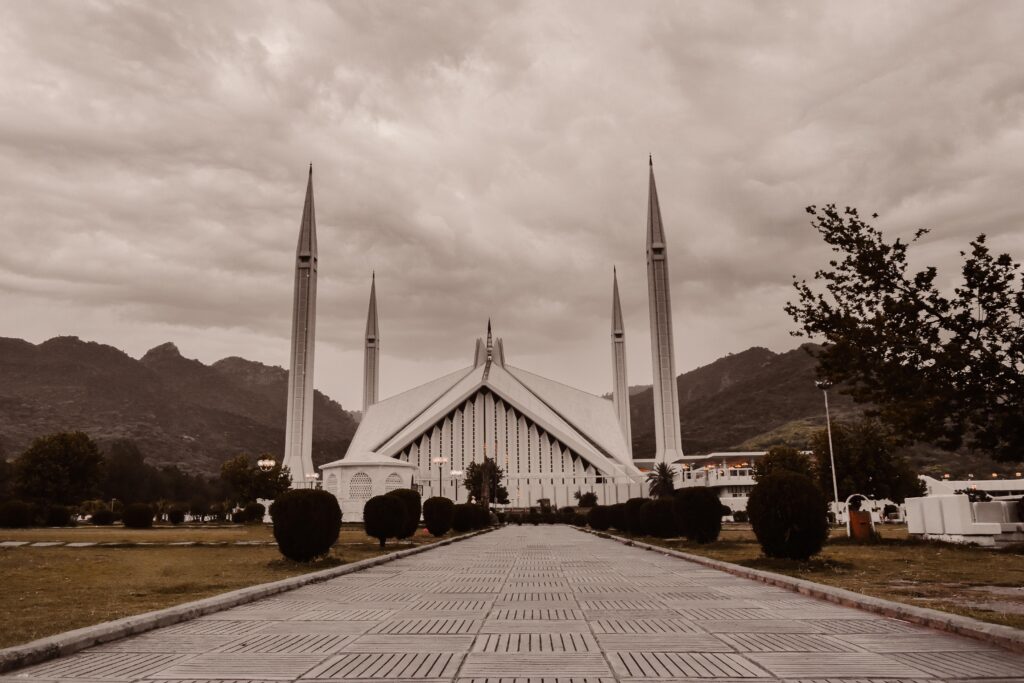
The mosque is set against the green slopes of the Margalla Hills. This white tent-shaped mosque looks like nothing, in the world.
It does not have a round dome.It does not have Mughal stone work It has lines.It has minarets that shoot into the sky.The design is so bold and so different.People still argue about whether it’s the most beautiful mosque they have ever seen or the most surprising one.
Either way they never forget the Faisal Mosque.They never forget it.
What Exactly Is the Faisal Mosque?
The faisal mosque is pakistan National mosque. it sits in Islamabad , the capital of Pakistan, In the north edges of City witht he Margalla Hills.
for the long time it held the title of being the largest mosque in the world, but later it was overtake by other mosque but still Faisal mosque is one of the most Beautiful and most visited mosque in the world.
A King’s Gift to Pakistan:
The mosque is named after the King Faisal Bin Abdulaziz Of saudi Arabia, and the name isn’t just for the honorary. He actually paid for the whole thing. its wsa gift from him to Pakistan.
back in 1960s, Pakistan had just moved it’s capital from karachi to Islamabad. the capital. was being planed from nothing and then Government think the Capital need it’s Mosque.
King faisal who was know for his Generosity in whole muslim world offer funds for the project himself. and pakistan accept his offer and work on this Mosque was started, and design competition was launched.
architecture from all over the world submit their ides for how the mosque should look like. and the winning design came from turkey by Vedat Dalokay.
after that the construction was stared in 1976 and it took ten year to complete the project. but king Faisal never saw it himself because he was assassinated in 1975.
there for naming that mosque on his name was the way of Pakistan saying thanks to him.
How Big Is It?
Big, but not in such an imposing manner.
The prayer chamber is able to accommodate as many as 10,000 people simultaneously, while with the inclusion of the surrounding courtyards and porticoes,
which encircle the mosque structure, the total capacity rises to 300,000 individuals. During a grand Friday, or during Eid occasions, such a capacity is usually filled to the brim.
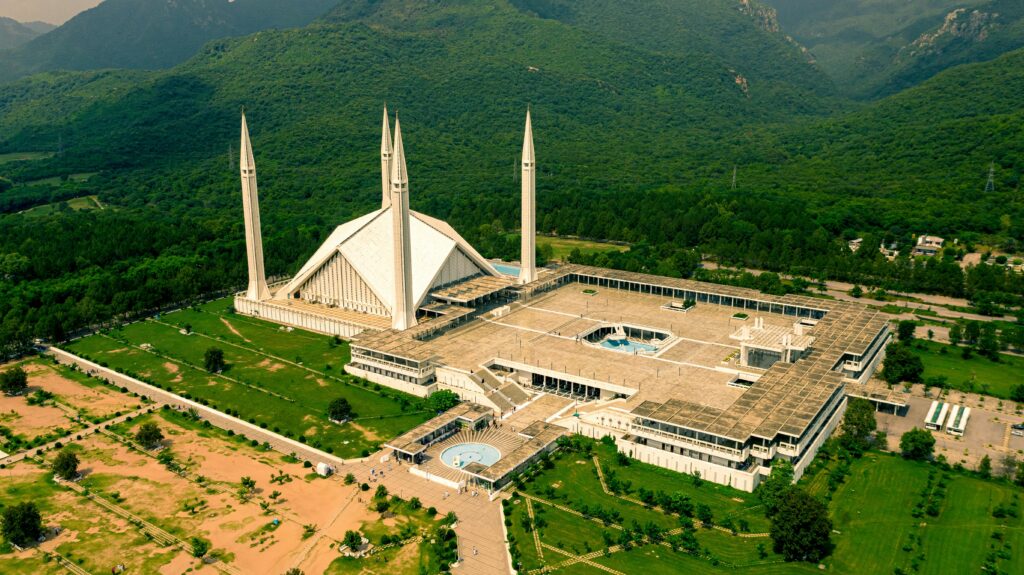
There are four minarets in the mosque, with each one being as high as 88 metres. Minarets are not very broad, heavy or bulky. Rather, they are slender, giving the mosque an elegant outlook with the needle-like structures rising towards the sky.
From anywhere in the vicinity, the minarets can be easily identified as they stand out from the rest of the area. In terms of sizes, the mosque structure occupies around 5,000 square metres while its wider complex takes about 19 hectares.
In spite of all this greatness, the Faisal Mosque does not appear to intimidate anyone in any manner whatsoever.
Inside the Mosque:
The exterior of Mosque may shock you , but the inside calms you down. when You take your shoes off and step through the door and step onto the thick carpet and the first thing you feel is is the silence.
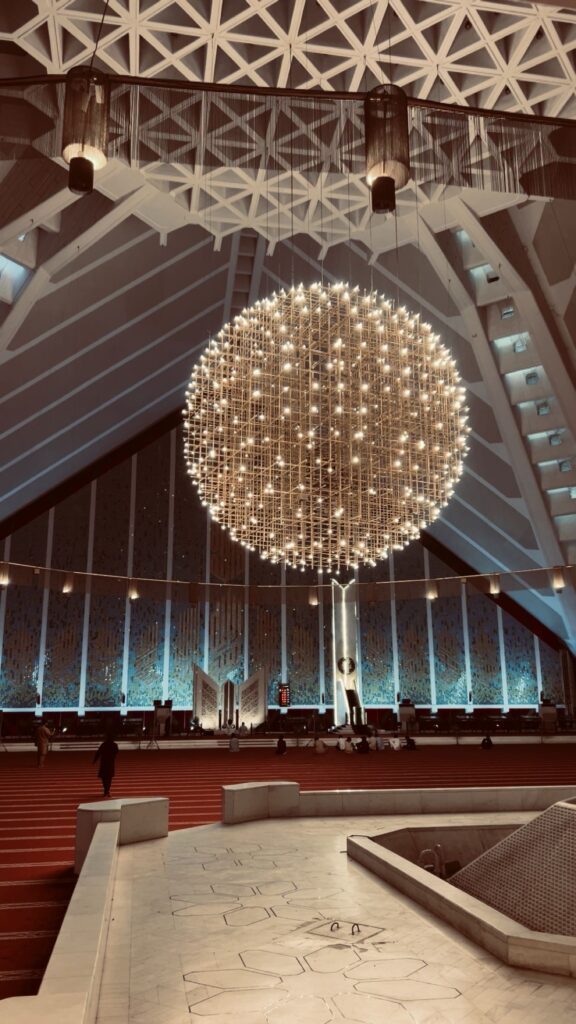
the Faisal Mosque is incredibly peaceful. The prayer hall itself is vast, and surprisingly, is unsupported by pillars. This vast open space only exaggerates its sheer size.
The walls are all calligraphy; and done by Sadequain; surely the finest artist ever from Pakistan. His art takes up significant sections of the walls, moving fluidly and aggressively over the surfaces.
It is not subtle nor timid. It is bold and the Arabic text is so dynamic you can imagine it moving before you eyes. The lower walls feature tiling of exquisite geometry and form
in blue, white and gold, and this looks almost Ottoman. This combination of modern calligraphy and classic geometric pattern looks strikingly out of place yet perfectly harmonious.
The room is lit by various gifts from Turkey and China in the form of light fittings, which produce a beautiful warm, golden light over the hall. The mihrab, which tells people which way to face,
also has decorative gold and blue mosaic tiles. It seems to draw the eye from anywhere in the room.
More Than Just a Mosque:
However many people come here to experience the architecture and to worship there is more to the Faisal mosque complex then just the hall.
There is a library containing many thousands of books on Islamic history, religion and culture that is accessed by Pakistani and international students and researchers.
This has led to the development of International Islamic University, located right next to the complex and very much associated with it.
There is a little cafe that you can sit at in order to give your feet a rest, where you look out at the Faisal mosque and the hills behind it.One of the places that time passes surprisingly quickly because of the view.
The lawns are lovely and it is very pleasant to stroll through the gardens in which the mosque stands, although in the spring these are even more beautiful with the presence of blooming flowers.
The pathways around the lawns also provide for a quiet and contemplative sitting place.
When to Visit and What to Expect:
Best time to visit the mosque is Early in Morning from 8am to 10am.as in the morning the visitors are very few therefor The early morning air is way cooler than later, and the white marble of the building is lit warmly by the morning sun.
Midday in the summer months can be unbearably hot. The stone floors and the concrete walk from the parking lot feel positively scalding, and while the visit is enjoyable, take water, comfortable shoes, and avoid this time if at all possible, or head straight there from breakfast.
Fridays are busy days as thousands of worshipers attend Friday prayers. You will not get quiet solitude on a Friday. You will however, feel the buzz and vibrancy of the building on this particular day. If space and quiet are your goals, stick to weekday mornings.
Ramadan evenings are very special.
The building is crammed for the nightly Taraweeh prayers. The experience-all those people gathered to worship, the echo of the recitation off the hills and through the vast expanse of the mosque-is indescribable.
A Few Things to Remember Before You Go:
Take your shoes off before going into the prayer room. Dress conservatively-for men and women arms and legs should be covered and women should cover their heads.
If you don’t have a scarf with you they have scarves at the door for you to use.
It’s acceptable to take pictures in the outside grounds and gardens but it’s your call inside the prayer room. there for In respect put the camera down.
even non muslims are welcome to the mosque .
The building is open to whoever shows up ready to be observant with good intentions. You don’t have to be Muslim to find this a profound place to be and most people do, no matter their faith.
Location:
It’s on Faisal Avenue in the F-6 Sector of Islamabad, clearly signposted and extremely accessible by taxi, rickshaw, or the plethora of ride-sharing services available in Pakistan’s capital.
It takes 30-40 minutes by taxi from Rawalpindi, depending on traffic. From Lahore via car, Islamabad is approximately five hours away; upon reaching Islamabad, it’s one of the first prominent points of reference to visit.
Parking is available close by the entrance, the walk from car to the mosque itself isn’t very long, and the sight as one arrives – the tall minarets towering over the trees, the mountains in the distance – makes for an arrival all in itself.
Why It Still Means So Much:
Pakistan has A lot of beautiful mosques, and they range in style and significance from the ancient and spiritual to the opulent and grandiose. But this is the national one. And ‘national’ has a gravity that the rest don’t.
When this building was erected, Pakistan was a newly formed nation in search of an identity.
The decision to erect something entirely modern; something that didn’t merely mimic the established Islamic masterpieces of the Mughal or Ottoman world; suggested something profound.
It declared that Pakistan could pay homage to Islam while embracing the future. Faith and modernity are not mutually exclusive; a Muslim nation was capable of forging a bold, individual aesthetic entirely its own.
The message remains relevant, perhaps even more so today than it did when it was first proclaimed. The faithful arrive to pray here every day, students find a peaceful place to study on the surrounding slopes and families arrive, on a Sunday in Pakistan, in huge numbers from all over the city. It embraces all of them.
Final Thoughts:
Some places are beautiful. Some places are historic. Some places are profound. Faisal Mosque achieves all of them at once, which is more difficult than it looks.
Visit the site early. Wander at a leisurely pace. Spend some time sitting in the gardens. Gaze up at those four minarets against whatever the day has on offer for the sky-blue and airy, or grey and ponderous-it makes no difference. The mosque is equally spectacular under any conditions.
Once inside, just pause, and take in the enormous space without any fuss. You will then know why the mosque is such an enduring attraction.